Distributor Training · Training & Development
Distributor Training Program for Manufacturers:
Build a Proven Scalable System in 7 Steps
A distributor training program for manufacturers usually starts strong and ends in a folder nobody opens. Here’s how to build a scalable system instead.
A distributor training program for manufacturers usually starts with good intentions and ends in a folder nobody opens. Product PDFs get sent. A webinar gets recorded. Sales teams assume the channel will figure it out. Then the same problems repeat: slow ramp-up, wrong positioning, inconsistent messaging, weak product knowledge, and distributors selling whatever is easiest instead.
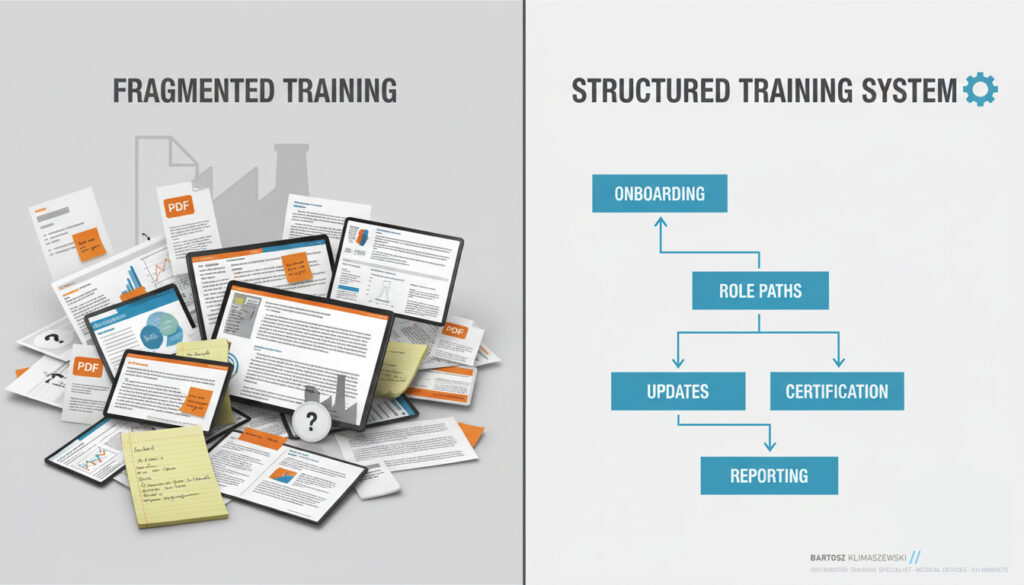
The issue is not that distributors do not want training. The issue is that most manufacturers do not build a distributor training system. They run isolated training activities and call it a program.
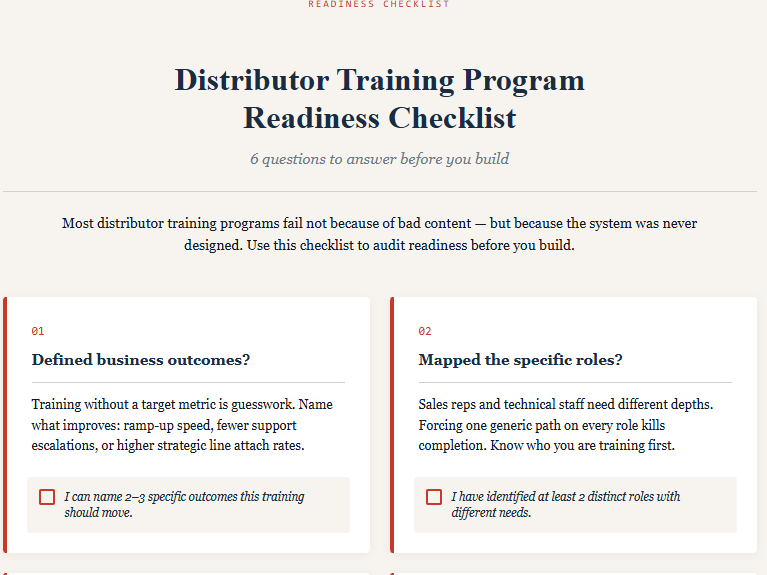
If you want distributors to sell confidently and consistently, training has to be treated as an operational system. That means clear outcomes, repeatable onboarding, role-specific learning, reinforcement, and a way to measure whether the training changes behavior in the field.
This article breaks down what a strong distributor onboarding program actually looks like, why most distributor product training underperforms, and how to build a scalable approach that works across markets and partner types.
What is a distributor training program for manufacturers?
A distributor training program for manufacturers is a structured system that helps channel partners understand, position, sell, support, and grow your products effectively.
That sounds obvious, but in practice many companies narrow training to product features alone. They teach what the product is, but not how to sell it, when to position it, how to compare it, how to onboard new distributor staff, or how to keep knowledge current over time.
A proper distributor training system covers five areas:
What you do, where you fit, what kind of customers you serve.
Features, use cases, configurations, limitations, updates.
Target buyer, value proposition, competitor comparisons, pricing logic.
Quoting, ordering, support, escalation paths, warranties, documentation.
Refreshers, certifications, launch updates, manager visibility, performance feedback.
The purpose is not only knowledge transfer. The purpose is channel performance. If your distributors know your product but still do not sell it well, your training has not done its job.
Why most distributor training programs fail
In many companies, distributor training grows reactively. A sales leader asks for onboarding materials. Product marketing adds a slide deck. Someone records a webinar after a launch. Regional teams create their own versions. After a year, there is a pile of content but no real system.
There are usually three factors behind failure.
Training is content-heavy and outcome-light
Most manufacturers produce information, not learning. They share catalogues, presentations, and technical sheets, then assume capability will follow. Distributors need to know what to say, when to say it, how to handle objections, and how to move from interest to sale. Static content rarely covers that well.
Nobody designs for distributor reality
Distributor teams are busy. Staff turnover can be high. Roles vary. Many work across multiple brands and product lines. When manufacturers deliver long, generic training without role-based paths or time-efficient formats, completion drops and retention drops with it.
There is no reinforcement or ownership
A one-off onboarding session is not a distributor onboarding program — it is an event. Without refreshers, manager visibility, update cycles, and simple accountability, knowledge fades quickly. New distributor hires never get trained properly. Legacy information stays in circulation.
What a scalable distributor training system actually looks like
A scalable system does not mean building a huge academy on day one. It means building training in a way that can be repeated, updated, localized, and measured without relying on constant manual effort.
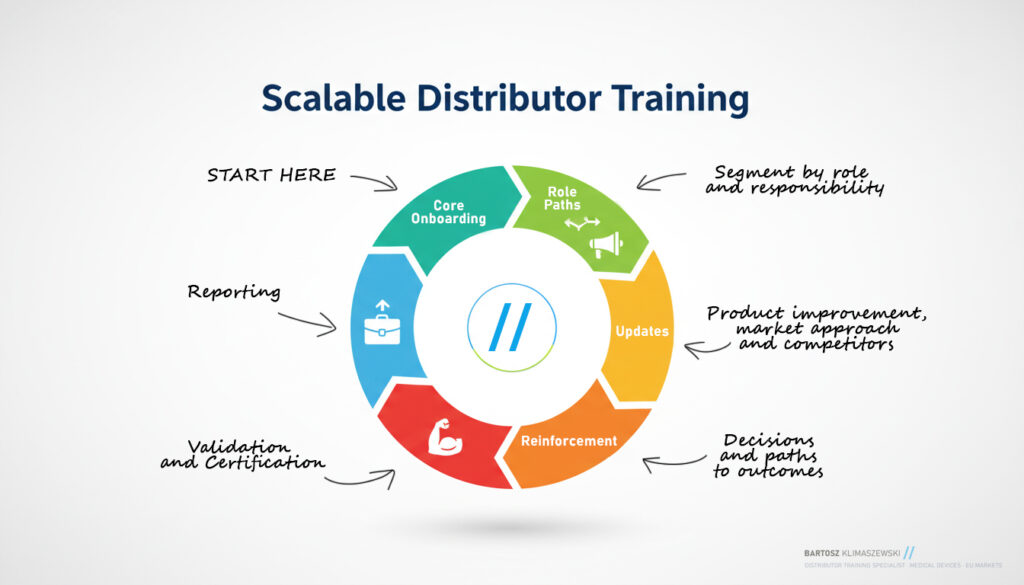
A useful model is to think in layers.
This staged structure helps in two ways. First, it improves completion because the first step feels manageable. Second, it reduces the gap between training and field application.
In practice, distributors engage more when they can use what they learn immediately.
The core elements of a strong distributor onboarding program
If your goal is to build a distributor onboarding program that scales, there are a few elements that matter more than the rest.
Clear role-based paths
Do not force every distributor contact through the same course stack. A sales rep needs positioning, qualification, objections, and competitor language. A service team needs diagnostics and support procedures. Segment by role and responsibility.
Simple learning architecture
The structure should be obvious. What is mandatory? What is optional? What should be completed first? If users have to guess where to start, adoption suffers.
Short, useful modules
Most distributor learners will not sit through a 90-minute product lecture. Break learning into focused modules — 5 to 15 minutes for core topics, combined with deeper reference content for those who need more detail.
Real-world sales and support scenarios
Distributors need context, not only information. Show them typical buyer questions, common objections, wrong-fit scenarios, and support handoff situations. That is where confidence usually comes from.
Accessible source of truth
Training should connect to a current knowledge base. If people complete training and then cannot find the latest pricing sheet or technical document, the system breaks.
Manager and channel visibility
Who has completed onboarding? Who is certified? Which regions are lagging? If your channel teams cannot answer those questions, your training system is probably too informal.
Content types that work best for distributor product training
Not every training asset should be a course. A good distributor training system uses multiple formats for different needs.
Best for structured onboarding, repeatable product basics, compliance topics, and consistent cross-market delivery.
Useful for launches, Q&A, market-specific updates, and commercial discussions where nuance matters.
Strong for day-to-day selling. Often more useful than long manuals because they support field execution directly.
Useful when products are visual, operational, or installation-dependent. Short demonstration clips often outperform written explanation.
Important when you need proof of readiness or a minimum standard. Certifications can also create internal status within distributor teams.
Useful as backup, not as the main training method. Documents should support the system, not replace it.
How to keep distributor training scalable across markets
Scale creates a different set of problems. The first version of training may work well with a small distributor network. Then the business expands. More regions join. Product lines increase. Local teams adapt materials. Soon the system becomes fragmented again.
This usually happens because the training architecture was never designed for scale. A few principles help.
Build a global core with local layers. Keep core product truth, brand positioning, and critical operating processes centrally controlled. Then allow local adaptation where needed for language, regulations, market examples, and channel structure. This prevents chaos without forcing unrealistic standardization.
TIP Use templates for new product and update training
Every launch should not start from zero. Create standard formats for launch modules, update briefings, product comparison assets, and certification updates. That reduces time to deployment and improves consistency.
TIP Assign content ownership
Who owns product accuracy? Who updates commercial messaging? Who retires outdated content? Without ownership, scalability turns into duplication.
TIP Choose a delivery platform that supports partner access
If your LMS or portal makes distributor access painful, adoption will suffer. The system needs to be easy to access, simple to navigate, and suitable for external users. See our demo on how we approach this.
What to measure in a distributor training program
A lot of teams stop at completion rates. That is understandable — completion is easy to track. It is also not enough. The real question is whether the training changes distributor behavior and improves channel performance.
Participation metrics
Who enrolled, who completed, time to completion, certification coverage, repeat usage. These show adoption, not impact.
Knowledge metrics
Assessment scores, pass rates, confidence checks, common error areas. These show whether people understood the material.
Operational metrics
Reduction in support errors, fewer order mistakes, faster onboarding for new partner staff, lower dependency on manual explanations from your internal team. These often reveal the practical value of a training system.
Commercial metrics
Faster time to first sale, broader product mix sold, improved conversion on key lines, higher attach rates, increased participation in launches. Attribution is not always clean, but patterns matter.
The point is not to create a perfect analytics model. The point is to connect learning to channel execution.

A practical framework for building your distributor training system
If you want to move from scattered training to a real system, start with a straightforward sequence.
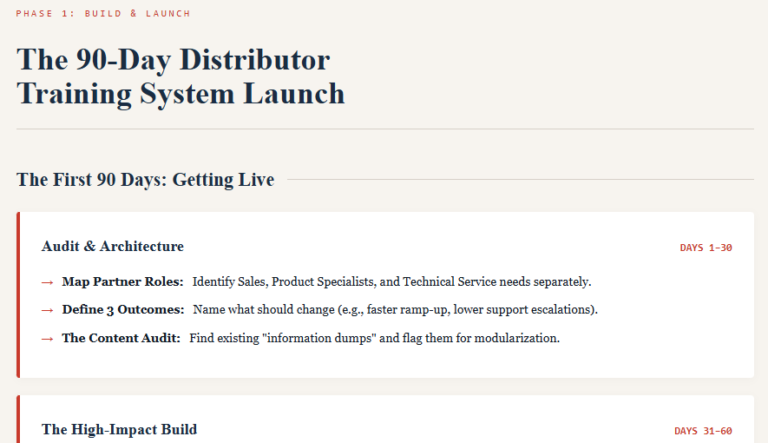
Define business outcomes
What should improve if training works? Faster distributor ramp-up? Better product positioning? Fewer support issues? Start there, not with content.
Map distributor roles and priority audiences
Not every partner needs the same training depth. Identify the roles that influence selling, support, and growth most directly.
Audit existing training assets
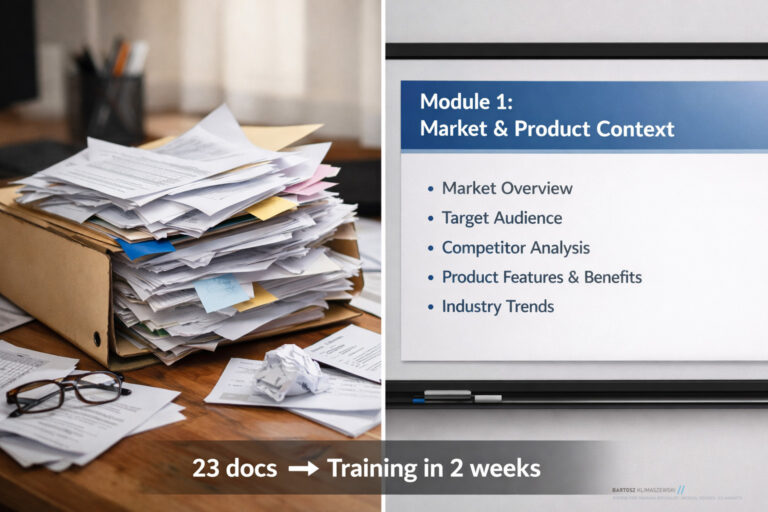
Most manufacturers already have useful material. The problem is usually that it is fragmented, outdated, or not designed for learning. Audit what exists before creating new content.
Build a modular curriculum
Turn the essentials into a structured path: onboarding, role-based modules, product updates, reinforcement, certification.
Create governance and ownership
Decide who updates what, how often content is reviewed, how regional variations are managed, and how new product training is deployed.
Launch with a manageable pilot
Pick a region, product line, or distributor group. Test the structure. Watch where people drop off. Listen to channel managers. Improve before scaling.
Measure and refine continuously
Training systems improve through use. Review completion, feedback, support issues, and channel performance patterns. Then adjust. This is not complicated in principle — it just requires discipline.
Final thought: distributor training is not a side activity
Manufacturers often say distributors are strategic partners. Then they train them like an afterthought.
That gap shows up quickly in the market.
A strong distributor training program for manufacturers does more than transfer product knowledge. It improves consistency, reduces dependency on ad hoc support, speeds up onboarding, and gives distributors a clearer reason to push your products over someone else’s.
The companies that do this well usually treat distributor education as part of channel operations — not as a pile of assets owned by whoever had time to create them.
If you are trying to work out how to train distributors effectively, start by dropping the idea that more content will fix the problem. Build a distributor training system instead.
That is what scales.
Need to build a distributor training system?
I design and build training programs for medical device manufacturers entering EU distribution markets. From documentation to delivery — in two weeks.
Get in touch