Outsource Distributor Training · Case Study · Distributor Product Knowledge Training
How to Outsource Distributor Training:
23 Documents to a Working Program in 2 Weeks
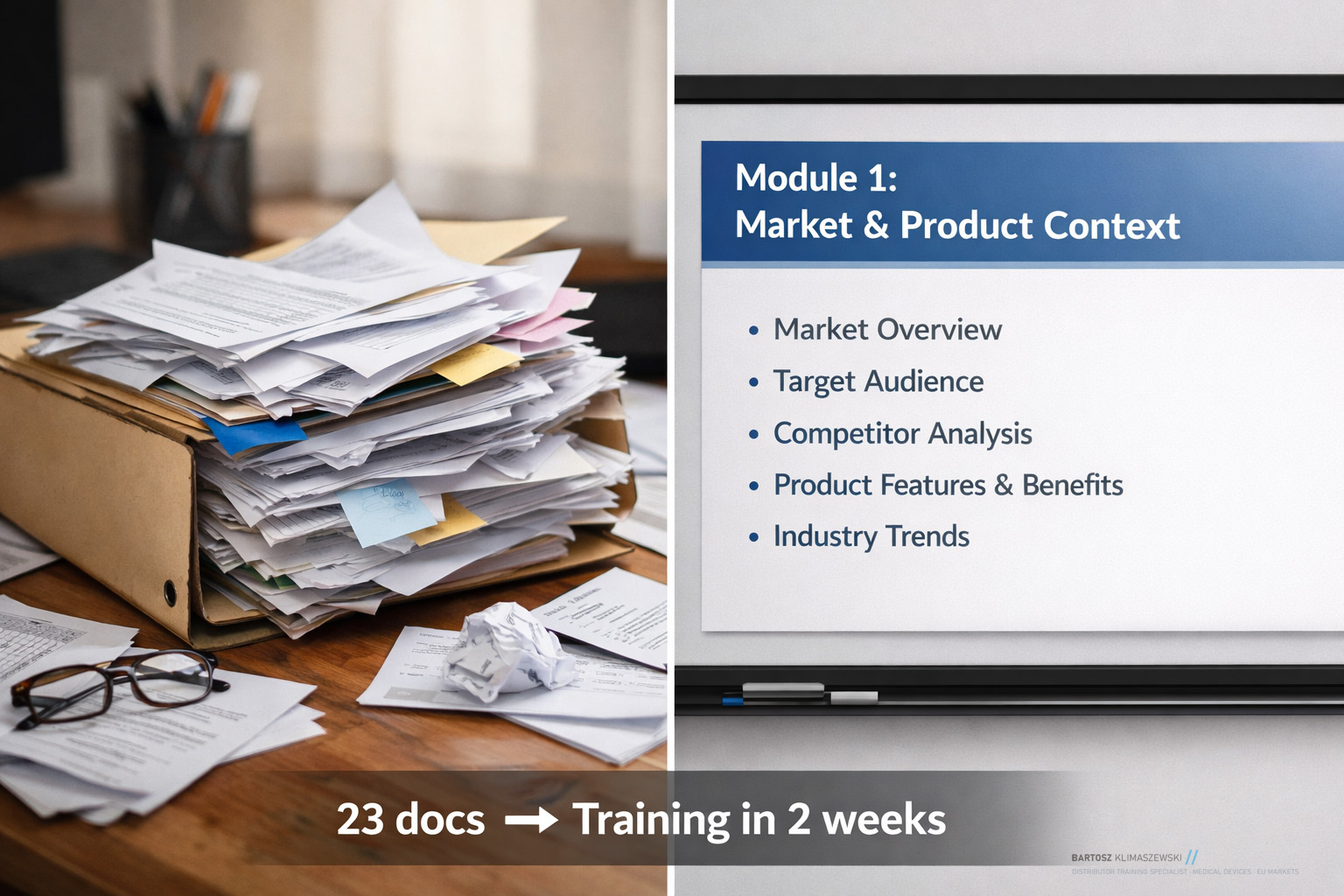
A manufacturer came to me needing to outsource distributor training — fast. 23 documents, 4 folders, a shared drive nobody had opened since 2021. Here’s exactly what I did with them.
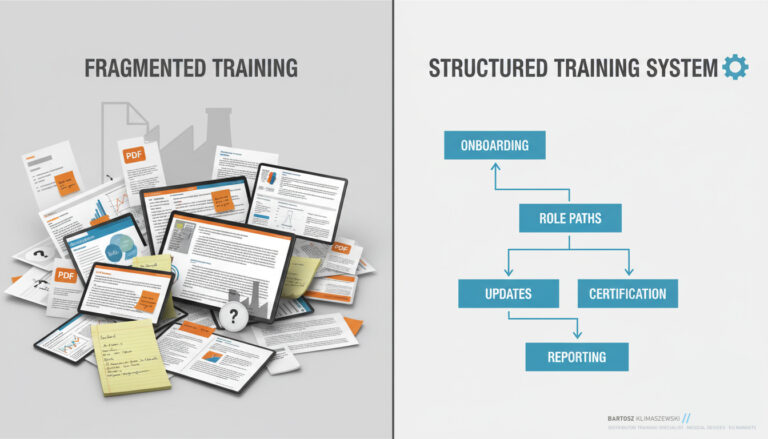
A lot of companies think they have training because they have documentation. What they actually have is a folder. Full of PDFs, slide decks, product sheets, technical notes, and onboarding materials written at different times, for different purposes, by different people. That is not training. That is inventory.
I recently had a manufacturer come to me needing to outsource distributor training — no internal team, no time, a new market push coming, and 23 separate documents spread across 4 folders. Distributors were expected to sell and support the product range properly. The brief was clear: turn scattered information into something people could actually learn from, and do it in two weeks.
This is the behind-the-scenes walkthrough of how that build worked — and what it means if you’re looking at the same situation right now.
When you outsource distributor training, this is what arrives first: a document dump
The raw input looked exactly like you’d expect. An IFU — dense, regulatory, written for clinicians not distributors. A procedure guide. A sales objection handler that hadn’t been touched since 2019 — you could tell because it still had a sticky note from someone called K.B. apologising that a training video wasn’t ready yet. A PowerPoint from the same year that referenced pricing which no longer existed.
Plus brochures, technical specifications, FAQs, compliance summaries, bits of commercial messaging, and a few internal documents that only made sense if you were already inside the company. Some files overlapped. Some contradicted each other. Some were strong on technical detail but useless for a distributor conversation.
This is a common pattern. Companies often have a lot of information, but no learning structure. That distinction matters. Information answers the question: what exists? Training answers different questions: what does a distributor need to know, in what order, at what depth, and for what practical use?
If you want to know how to train distributors on new product lines, this is usually the real bottleneck. Not missing content. Missing structure.

The real problem with distributor product knowledge training: information does not transfer knowledge
The client did not need another polished slide deck. They needed distributor training without their internal team tied up for months.
Documentation is almost always written from the company’s point of view. The product team documents engineering details. Marketing documents market positioning. Sales documents objections and value points. Support documents recurring issues. A distributor, however, needs a blended version of all of that.
They need to know what the product is, where it fits, who it’s for, how it differs from alternatives, what to say in early conversations, what not to say, what level of technical understanding is expected, and when to escalate to the manufacturer. Until those things are organised properly, the material stays reference content — not training content.
The issue is not whether the material exists. The issue is whether a distributor can move through it and come out with usable product understanding, consistent messaging, and enough confidence to speak to customers without improvising badly.
Step 1 — Extraction
The first stage was not design. It was extraction.
I went through every document and pulled out the pieces that actually mattered for learning. Not every paragraph deserved to survive. A lot of content was repetitive, overly internal, or too detailed for the audience. What I extracted fell into recognisable buckets:
What it is, how it works, what configurations exist.
How the range fits together. What to recommend when.
Real scenarios. Who buys this, why, in what situation.
What makes this better, different, or more appropriate.
The language distributors need to understand and use correctly.
What a distributor needs to know — and where their responsibility ends.
The questions that come up on every call. Standardised answers.
When to stop and call in the manufacturer. Defined, not assumed.
Ordering, support paths, compliance requirements.
This phase is where most of the real thinking happens. Because once you can see the actual knowledge components clearly, the shape of the training starts to emerge. But extraction also surfaces three problems that show up in almost every document pile:
Duplication
The same point appearing in multiple files with slightly different wording. Inconsistent enough to confuse. Similar enough that nobody noticed.
Inconsistency
One file describes a feature one way. Another simplifies it. A third implies something slightly different. A distributor reading all three walks away uncertain.
Audience mismatch
Material clearly written for internal teams, not channel partners. The IFU is a good example — accurate and detailed, but written for clinical professionals, not sales reps preparing for a hospital call.
Step 2 — Mapping: how to train distributors on new product without repeating the document structure
After extraction, I did not build modules based on document titles. I mapped the content to the distributor’s job. Not to the company’s internal file structure. Distributors don’t think about IFUs and procedure guides when preparing for a hospital call. They think about what they need to be able to say, what they need to not get wrong, and what happens if they can’t answer a question.
That means the learning flow needs to follow their logic, not yours. A practical learning path looks something like this:
That order matters more than people realise. One of the most common mistakes is dropping distributors into detailed product specifications before they have commercial context. The result is predictable: low retention, weak confidence, inconsistent messaging. When you sequence understanding correctly, everything that follows actually sticks.
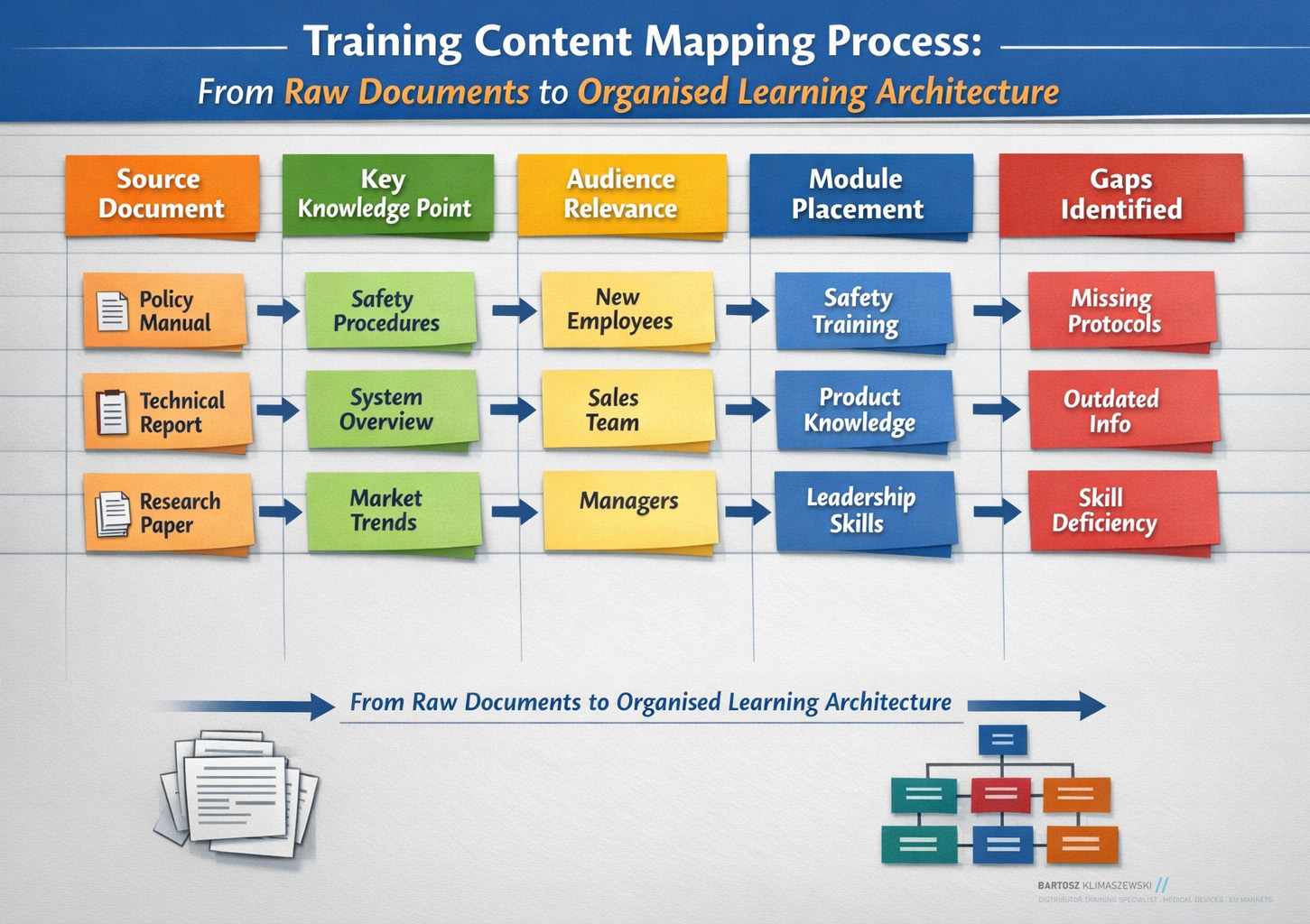
Step 3 — Remove noise, fill gaps
No set of source documents arrives clean. Some content has to be cut because it adds complexity without helping performance. Some has to be rewritten because the original is too technical, too vague, or too internal. And some gaps have to be filled because nobody created the missing explanation in the first place.
There were places where the company had excellent technical documentation but weak plain-English explanation. Places where the value proposition existed in marketing language, but not in a form a distributor could use in an actual conversation. So part of the work was translation. Not between languages — between internal knowledge and distributor-ready knowledge.
This is also where scope discipline matters. A distributor does not need to become your product engineer. They need enough knowledge to sell, position, and support the product responsibly. Overload the program and completion drops — confidence often gets worse, not better.
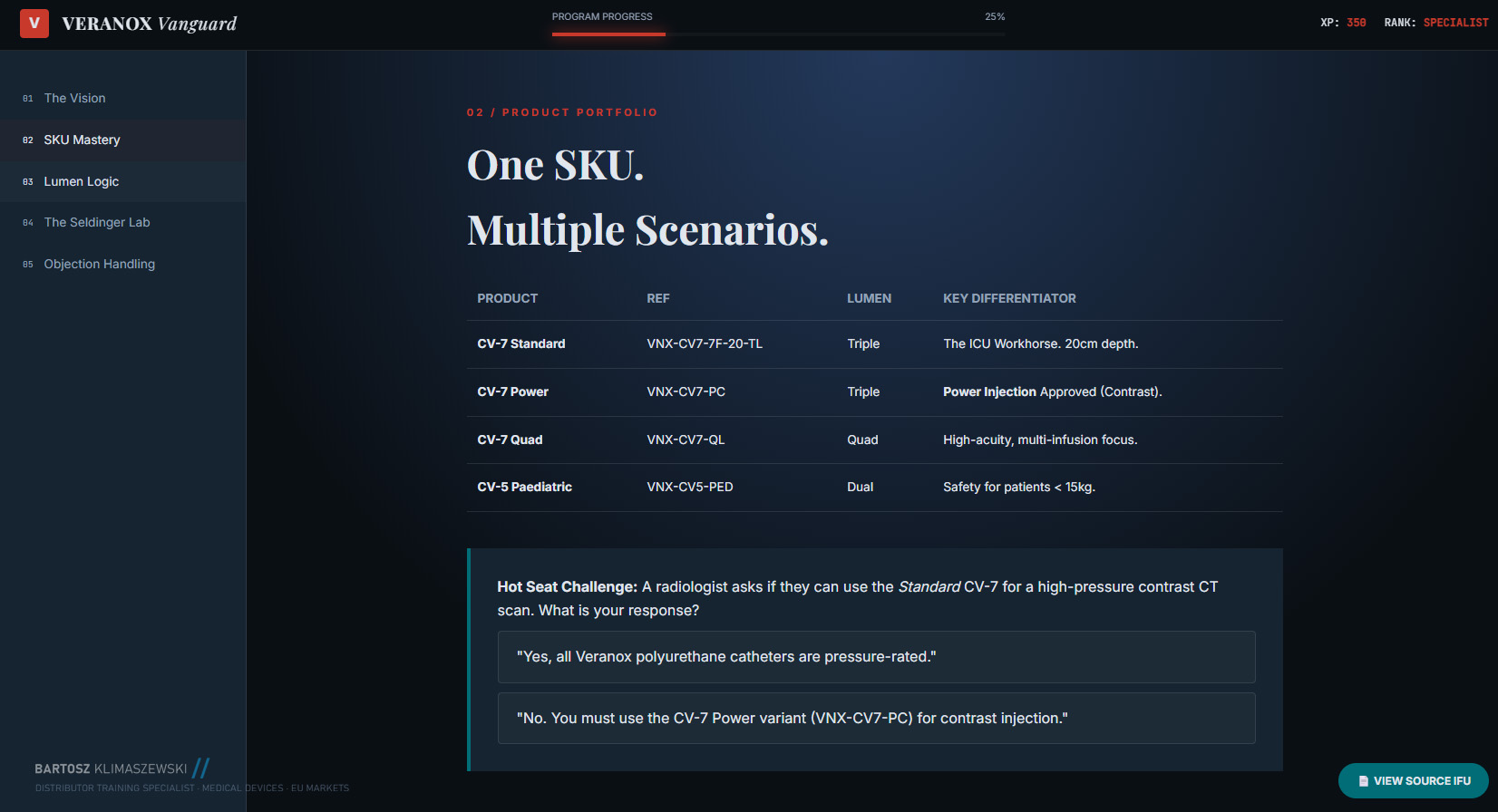
What the finished program actually looked like
At the end of two weeks, the output was not a cleaned-up folder. It was a usable training program.
Modules in a logical sequence. Each one with a defined outcome. No guessing where to start.
One version of the truth across the portfolio. No more contradictions between documents.
Value statements a rep can actually use. Not internal brand copy. Field-ready language.
Where each product fits. Who buys it. What the conversation typically looks like.
Clear escalation points. What the distributor handles. What goes back to the manufacturer.
Confirmation that the material landed. Trackable. Expandable as the program grows.
The 23 documents are still there. They are still the source. But they are no longer the product. That is the shift.
The first version of a distributor training program does not need to be huge. It needs to be coherent. A lot of companies delay because they imagine a large, perfect academy. The better move is almost always to build a strong operational version first, then improve it based on real usage and feedback.
Why this worked in two weeks — and why distributor training without internal resources is often faster to outsource
People sometimes assume the speed comes from templates or automation. That’s part of it. The bigger reason is that the process stays focused. When you outsource distributor training to someone external, you’re not just buying execution — you’re buying the discipline to make decisions your internal team keeps deferring. I was not trying to preserve every document. I was trying to produce a working learning system. That means making certain decisions early and not going back on them:
What belongs in training vs. what stays as reference
Not everything in the pile deserves a module. Making that call early — and holding to it — saves days.
What needs client clarification vs. what can be decided
Two or three focused clarification calls, not a weekly review cycle. Ask everything at once, move forward.
What can be simplified without losing accuracy
Most technical content can be explained in a quarter of the words without losing anything a distributor actually needs.
What the audience needs to be able to do at the end
Start from the outcome. Work backwards. Every module either serves that outcome or it gets cut.
This is also why it makes sense to outsource distributor training when the internal team is stretched. Product, marketing, and sales teams usually know the material well — but they don’t have the time or distance to turn it into structured learning. Distributor training without internal resources dedicated to the build almost always stalls. An external process creates momentum and forces structure.
What this means for your distributor product knowledge training
If you already have a pile of product documents, you are probably closer than you think. But you still do not have distributor product knowledge training.
That is the key point.
You do not need to start from zero. You do need to convert what you have into a form people can actually learn from. A new distributor should be able to understand the product, position it correctly, and know their limits — without needing three extra calls with your internal team before their first hospital visit. That is the benchmark for how to train distributors on new product properly.
If the answer to that question is no, the problem is probably not missing information. It is missing conversion.
A common pattern: the company has enough raw material to support training, but not enough time, structure, or internal ownership to turn it into a coherent program. As a result, distributors get overloaded with files, undertrained on product knowledge, and left to build their own version of the story. That is expensive. It shows up as slow onboarding, inconsistent sales conversations, avoidable support issues, and weaker market traction than the product deserves.
The practical implication is straightforward. If your documentation is scattered, inconsistent, or written for internal use — it can still become a strong distributor program. But it needs to be built, not just shared.
That is the difference between sending files and creating capability.
Ready to outsource distributor training — without the usual 3-month build?
Send me what you have. I’ll turn your documentation into distributor product knowledge training your reps can actually use — in two weeks.
Send me your documentation →